Showing posts with label Fine Tuning. Show all posts

Wednesday, November 26, 2014

Rare Earth: The Moon


I’m at home today with a sick child who decided she wants to watch science programs about the universe.  As a nerd that is fascinated by cosmology, this made me extremely happy!  One of the programs she wanted to see is called, “The Day the Moon was Gone”, which can be watched here.  What I found fascinating about this video is just how dependent the Earth is on the moon to support complex life, which I think is part of an emerging cumulative case that can be made for the Earth being fine-tuned for life.


The current hypothesis on how the moon formed is that a Mars-sized planet was flung to Earth by Jupiter’s gravitational forces.  Moon rocks and the Earth’s crust share oxygen isotope ratios not found anywhere else in the solar system.  This is evidence that the moon and Earth were either a single body or somehow came in contact with one another in such a way that they share surface material.


Plate Tectonics
The “impactor” hit the Earth while the Earth was still molten, which may have allowed just the right amount of iron to be added back into the Earth’s core.  If too much iron had been added, Earth’s gravity would be stronger making running, throwing, and growing more difficult, but probably not a life-ender for simple life-forms.  Not enough iron and the Earth would have cooled too quickly for plate tectonics to have formed, which would have preventing life from forming.  Plate tectonics are vital for life for the following reasons:

·      Plate tectonics created continents for life on land and shallow seas.

·      Gases released from volcanic activity and cracks in the crust created the atmosphere.

·      Plate movements cycle nutrients that make oceanic life possible.

·      Plate tectonics creates a silicate/carbonate cycle that regulates the Earth’s temperature and CO2 content.

Tides
The Sun is 400 times farther away than the moon, but has a strong gravitational pull on the Earth.  The moon is ¼ of the size of the Earth, which is relatively large for a moon; practically its own planet.  The large mass of the moon is needed to have enough gravitational impact to affect the Earth and to counter the impact of the sun’s gravity.  Without the gravitational influence of the moon, the sun would create large tidal bulges across the Earth that would create daily, world-wide, tsunamis. 

The factors of 400x distance to the sun and ¼ size of the Earth create almost perfect solar eclipse that was instrumental in determining the composition of the sun through spectrum analysis, and by extension, the composition of other stars in the universe.  The solar eclipses were also used to test the Theory of General Relativity in its infancy.  A slightly imperfect eclipse turns out to be perfect for learning more about our universe.
 
Climate
It’s also believed that the impact from the moon gave the Earth its current tilt angle and rotation speed.  The tilt and slight wobble around the axis gives the Earth the four seasons.  Without the moon, the Earth’s tilt would wobble so much around the axis that the climate change would be too extreme and too fast for complex life to adapt; one area’s tropics would be tomorrow’s ice sheet.

While the Earth was still molten, the moon’s gravity caused a tidal bulge of lava, which created a drag on the Earth’s rotation causing it to slow down.  The result is Earth’s rotation slowed from 8 hours per day to 24 hours per day.  The faster rotation would result in stronger winds and violent storms, and also shorter day/night cycles which would be difficult to complex life to form.  A faster rotation would also cause the magnetic field to increase, which would result in less radiation hitting the Earth.  Conversely, too slow of a rotation would weaken the magnetic field and allow too much radiation into the atmosphere.

Heavy Metals
This isn’t related to the moon, but is an interesting piece of information covered in the video.  There was a period called the Heavy Bombardment, where the Earth and the moon underwent significant impacts from asteroids after the Earth had cooled to the point of having a hard crust.  This allowed heavy metals such as iron, lead, uranium, gold, etc, to be near the surface and accessible to humans.  If the bombardment had occurred much sooner, the Earth would have still be molten causing the heavy metals to sink to the core.  Much later and life would have been obliterated.  The Heavy Bombardment isn’t critical for life to form, but it has been critical in human life flourishing.
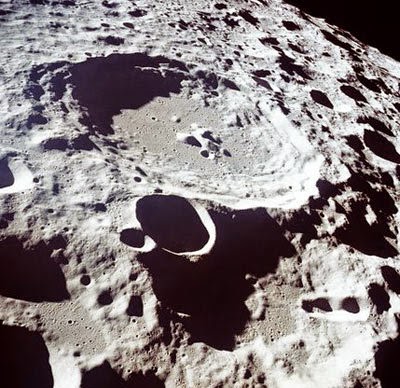
 
As Hugh Ross says, maybe this Thanksgiving we should say thanks for not only the food that sustains our lives, but also the moon.


Sunday, March 16, 2014

Roger Penrose on entropy: How did he calculate that?

 
One of the fine-tuning arguments frequently used is the low entropy state of the universe at the Big Bang.  This was calculated by Roger Penrose to be 1:1010123.  How does he do this?  He explains it in his book, The Emperor’s New Mind.  Here is the section of the book that discusses it.   Penrose uses the Bekenstein-Hawking formula for the entropy of a particle in a black hole to determine the entropy of a particle at the singularity of the Big Bang as if the entire universe were a giant black hole.  He calculates this to be 1043.  There are estimated to be 1080 particles in the observable universe. 
 
1080 x 1043 = 10123 . 
Entropy is on a logarithmic scale, so that is how he arrives at 1010123. 

V = total phase-space volume available
W = original phase-space volume

V/W = 1010123

 
Therefore, the accuracy of the low entropy value was 1:1010123.  Penrose says,

“This is an extraordinary figure. One could not possibly even write the number down in full, in the ordinary denary notation: it would be `1' followed by 10123 successive `0 's! Even if we were to write a `0' on each separate proton and on each separate neutron in the entire universe-and we could throw in all the other particles as well for good measure-we should fall far short of writing down the figure needed. The precision needed to set the universe on its course is seen to be in no way inferior to all that extraordinary precision that we have already become accustomed to in the superb dynamical equations (Newton's, Maxwell's, Einstein's) which govern the behaviour of things from moment to moment.”
 
If there are more particles in the universe than 1080 (like an infinite number), all the more extraordinary!!

Sean Carroll pointed out in his debate with William Lane Craig that this low entropy value was not a requirement for life to exist and, therefore, should not be considered finely tuned by a creator.  As I discussed here, Robin Collins addresses this in his paper claiming that without a low entropy at the Big Bang, we would not know that our universe had a beginning and some of our fundamental laws of physics would not have been discovered.

Friday, March 7, 2014

The Fine-Tuning for Discoverability


The recent debate with Sean Carroll and William Lane Craig on February 21, 2014 had a different format than most debates.  Craig and Carroll debated on a Friday night, but then each brought two other people with them to write companion paper’s to support/refute the various positions and give a talk the following morning.  Sean Carroll brought Tim Mauldin and Alex Rosenberg.  William Lane Craig brought Robin Collins and James Sinclair.  I haven’t had time to look at the debate in depth yet, but on the surface it was a great exchange with lots of scientific details.  Sean Carroll held his own quite well, and holding your own against WLC is almost a default victory.  Not all of the videos are posted yet.  I can say the talk Tim Mauldin gave was a snooze….a giant ‘we don’t know anything and don’t need God either’. 

William Lane Craig
Sean Carroll


One of the arguments Craig uses that points to an intelligent creator is the fine-tuning for life.  Carroll claims we have no evidence to suggest the universe is fine-tuned for life.  An example he uses is Roger Penrose’s staggering calculation for the minimum entropy value at the Big Bang….1:1010123.  You could put a zero on every particle in the observable universe with more to spare.  It’s an unfathomably small number!!!  Carroll claims that the entropy of the early universe did not need to be that low for life to form, so it is actually an argument against the fine-tuning by a creator.  Queue Robin Collins.


Robin Collins
Robin Collins is an expert in the fine-tuning of universe.  His talk is not out on video yet, but he has published his companion paper called “The Fine-Tuning for Discoverability”.  He calls it the Discoverability Thesis.
 

“Discoverability Thesis: This thesis is that the universe is non-accidentally structured in such a way as to be highly discoverable.”


In other words, not only is the universe fine-tuned for life, but it is also finely tuned to allow for intelligent agents to be able to understand it.  Many of the fundamental constants and early universe conditions are not necessary for life, but are necessary if we are to be able to learn about the universe and life.  Collins claims to have found at least a dozen examples of fine-tuning for discoverability.

The low entropy condition at the Big Bang is one of them.  Carroll is correct in saying that the entropy could be higher and still support life, but having a low entropy helps our discoverability in two ways:

1)     A low entropy allows us to see other galaxies and a larger universe.  Without a low entropy, we would only see our galaxy.  We wouldn’t know that the universe was expanding or that it had a beginning.

2)    Without a low entropy in the beginning, the universe would not have a uniform distribution.  We wouldn’t be able to discover some of the fundamental laws that govern the universe, like General Relativity which assumes a uniform distribution throughout the universe.

The beginning of the universe points to a transcendent cause.  A universe that follows laws and can be rationally understood indicates a rational mind formed those laws. 

Another example of tuning for discoverability is the constant, α, that governs the electromagnetic force. 

“A small increase in α would have resulted in all open wood fires going out; yet harnessing fire was essential to the development of civilization, technology, and science – e.g., the forging of metals….. Going in the other direction, if α were decreased, light microscopes would have proportionality less resolving power without the size of living cells or other microscopic objects changing (when measured in atomic units).”

So a larger α means no open wood flames and a smaller α means we would not be able to examine living cells, both of which are very significant to discoverability and technological advancement.

Another example of fine-tuning discoverability is radioactive decay compared to the strength of gravity.  This allows us to study geology, archeology, and paleontology….all crucial in learning about life, the Earth, and history.

“the ability to use radioactive dating – which plays a crucial role in geology, archeology, and paleontology -- depends on the density of radioactive elements in the crust of the planet on which observers evolve. As the strength of gravity is decreased (e.g., as measured by the force between two protons a unit distance apart), the density of radioactive elements must decrease to keep the number of volcanoes per unit area from increasing, which would decrease livability.”

Some atheists, including Carroll, have claimed that extra, unnecessary particles show that the universe was not created by an intelligent agent since a designer would not include such unnecessary features.  This is merely a “Naturalism of the gaps” argument….. ‘I don’t know why a creator would do this, so there is no creator’.  One example is the muon.  Collins argues that the muon has played a very important role in our ability to learn about our universe and other particles.  He sites this article in Symmetry Magazine:

“The muon is one of 16 fundamental particles that make up everything—all matter, all forces, all energy—in the visible universe….The muon’s puzzling appearance and subsequent identification as a unique and autonomous particle perplexed scientists and revolutionized the field of particle physics. It was the precursor to the three generations of matter and opened the door for the discovery of quarks and other particles.”

“Today scientists can manipulate the muon and use it as a tool not only for particle physics research but also for cosmology, archeology and public safety. They have used muons to test special relativity and time dilation and to probe the interiors of pyramids for secret chambers. Today scientists use muons to image novel materials such as high-temperature superconductors, to study chemical reactions, to look for hidden nuclear weapons and even to determine things as delicate as the size of a proton.”

There is even talk of building a muon collider.  For an unnecessary particle, a lot has been learned because of it and this isn’t the end of what we will learn from the muon! 

Collins goes on to discuss the cosmic microwave background radiation and the dark energy coincidence problem, but that will have to be another post.  Needless to say, his paper is full of good info!!

How does the discoverability point to an intelligent creator?  If the entropy were higher, we would not know that our universe had a beginning and required a transcendent cause.  We also would not know some of the fundamental laws that govern our universe, which a rational universe provides evidence for a rational creator.  If the constant that governs the electromagnetic force, α, were higher, we wouldn’t have fire or anything that results from fire.  If α were lower, we would not be able to see living cells in a microscope.  If you want to know why that points to an intelligent mind, see Steven Meyer’s video on the cell.  Radioactive decay has allowed us to study geology, archeology, and paleontology….all crucial in learning about life, the Earth, and history.  The muon has opened the door to understand our universe at the particle level.

The more I learn, the more Romans 1 amazes me.  God truly has revealed his existence through what he has made.

Sunday, December 15, 2013

The Multi-Verse: Part I – Desperate to Avoid God


I really don’t know why I remember this conversation, but I do.  I had just started my freshman year of college and was talking to one of my classmates on a break.  He seemed like a hippie- type, so for him to say that our universe could be one of an infinite number of universes wasn’t surprising to me.  What is surprising to me is how the idea of a multi-verse is now part of mainstream science.  Just about every recently made program I watch regarding the universe preaches the possibility of the multi-verse as if it is true.  Even Nova made a video on the multi-verse.  Let’s be clear; it is only an idea.  It’s not a scientific theory.  A theory has evidence supporting it.  It’s not a scientific hypothesis.  A hypothesis is testable.  The multi-verse has neither supporting evidence nor is it testable, so why is it discussed (preached) in science?


The idea of the multi-verse has been around in science for decades, but it wasn’t taken seriously.  Scientists try to avoid theories that have no evidence and cannot be falsified.  Many claim to reject the existence of God for this reason, but now scientists actively discuss an idea that has no evidence and cannot be falsified.  Why has this changed?  The reason for the change is because the universe appears to have been fine-tuned to allow for life.  What does this mean?  The laws of physics have several constants contained in their equations that, should they vary in the slightest amount, our universe would not have been life permitting, if it had formed at all. 

The most extreme example of fine tuning is the Cosmological Constant which has been tuned to 1:10120 (120 decimal places).  If this had been a slightly smaller value, the universe would collapse on itself to form a giant black hole.  If this value had been slightly bigger, the universe would have flown apart so fast that atoms would not have formed.  Just for a scale reference, we’ve had 1017 seconds since time began and it’s estimated the all of the particles in the observable universe total around 1080.  I’ve included more examples below of finely tuned constants.

What is the best explanation for this?  As Leonard Susskind says in this video, “nobody thinks that’s accidental….that is not a reasonable idea that something is tuned to 120 decimal places just by accident”.  The more discoveries scientists make, the more it becomes clear that a designer is required to set these constants into the extremely narrow range.  If one were following the evidence, then a designer is the simplest explanation.  Yet many atheist scientists don’t allow for the option of a designer.  Sandra Faber explains how they get around the evidence:

“Faber declared that there were only two possible explanations for fine-tuning. “One is that there is a God and that God made it that way,” she said. But for Faber, an atheist, divine intervention is not the answer.  The only other approach that makes any sense is to argue that there really is an infinite, or a very big, ensemble of universes out there and we are in one,” she said.”

This Discover Magazine article discusses if there is an alternative to a creator, since the ‘fine-tuning problem’ indicates intelligence.

“Call it a fluke, a mystery, a miracle. Or call it the biggest problem in physics. Short of invoking a benevolent creator, many physicists see only one possible explanation: Our universe may be but one of perhaps infinitely many universes in an inconceivably vast multiverse.

“Advocates argue that, like it or not, the multiverse may well be the only viable non­religious explanation for what is often called the “fine-tuning problem”—the baffling observation that the laws of the universe seem custom-tailored to favor the emergence of life.”

“if there is no multiverse, where does that leave physicists? “If there is only one universe,” Carr says, “you might have to have a fine-tuner. If you don’t want God, you’d better have a multiverse.””

The probability that all of these constants and early universe conditions could be randomly set so precisely and accurately is so low that it is beyond comprehension.  Atheists often claim that there is no evidence for a designer, yet when they discover such evidence, they postulate an idea that has no evidence; an infinite number of universes.  The multi-verse is a faith-based claim, not a scientific hypothesis.  Good science does not come up with theories based on the need to avoid God. 

The fine-tuning of our universe was either caused by a designer or there are an infinite number of universes; one has evidence and the other has to be taken on blind faith.  As Bernard Carr said in the Discover Magazine article, “If you don’t want God, you’d better have a multiverse.”  Christians are free to follow the evidence where it leads; atheists must hold on to blind faith. 


Examples of fine tuning:
Cosmological Constant – 1:10120 – This is the energy of empty space (dark energy) that is causing the universe to expand.  If it were too high the universe flies apart so fast that atoms cannot form, too low and the universe collapses into a black hole.

Critical Density – 1:1015 – This is the density of the universe required so that it would neither expand nor contract (the density without the Cosmological Constant).  It’s value determines the shape of the universe; open, closed or flat.  If it were too high the universe flies apart, too low and the universe collapses into a black hole.

Universe Density – 1:1062 – The density of the universe is tune to 10-62 of the critical density required for a flat universe.  This has become known as the Flatness Problem.  Life requires an almost flat universe.

The Weak Force – 1:10100 – The weak force is what allows radioactive decay.  If it were too strong, only heavy elements (like iron) could form; too weak and only light elements (like hydrogen) could form.

Electromagnetic Force to Gravity – 1:1040 – If this ratio varied by 10-40, stars would only form either small red dwarfs or giant blue stars, neither of which can sustain life.

The Amplitude of Primordial Fluctuations (Q) – 1:105 – Q is a measure of the mix of atoms, dark energy, and radiation at the various points in space after the Big Bang (the distribution of the ‘stuff’).  The results are ‘ripples’ throughout space.  If the amplitude of these ripples were larger than 10-5, the resulting chaos would prevent star formation; smaller than 10-6 and the universe would collapse into black holes.

Hoyle Resonance – 1:105 – The Hoyle Resonance is a property of carbon-12 that allows both carbon and oxygen to be produced from stars.  A change in this state by 10-5 would result in either no carbon production or no oxygen production.  The Hoyle Resonance allows for both to be produced.

The mass of hydrogen converted into energy in stars – 0.007% - This is the percent of a hydrogen atom’s mass that is converted into energy from the nuclear reactions of stars.  If that percent were 0.006%, the universe would be full of hydrogen and nothing else.  If that percent were 0.008%, there would be no hydrogen which results in no stars like our sun or water.

Entropy – 1:1010123 This is the low entropy value Roger Penrose estimates our universe had at the Big Bang.  Entropy is the amount of order in the universe and never decreases over time.  You could literally take a zero from this number and put it on every particle in the observable universe with many zeroes left over.